By Ustarminer Engineering Team
A Bitcoin block reward consists of the block subsidy plus the transaction fees included in that block. If you mine through a service, its allocation rules determine how much of that gross reward reaches the winning participant.
There are two different kinds of “fee” to keep straight: transaction fees add to the gross block reward, while an operator fee may deduct from the participant's allocation. This guide follows the amount from block construction to the outputs you can inspect on-chain.
Contents

What does the coinbase transaction contain?
The first transaction in a Bitcoin block is the coinbase transaction. It can allocate the permitted newly created subsidy and the eligible fees collected from the block's other transactions. “Coinbase” here is a technical transaction category, not a reference to an exchange account.
A coinbase transaction can have multiple outputs. An operator's allocation can therefore appear as separate outputs rather than as one deposit followed by a later deduction. Inspect the actual transaction when verifying a claimed payment.
Bitcoin's developer references explain the coinbase structure and block construction. Some examples retain older subsidy amounts, so use them for mechanisms rather than silently treating those figures as present-day rewards. Block structure reference · Mining guide
How does block height determine the subsidy?
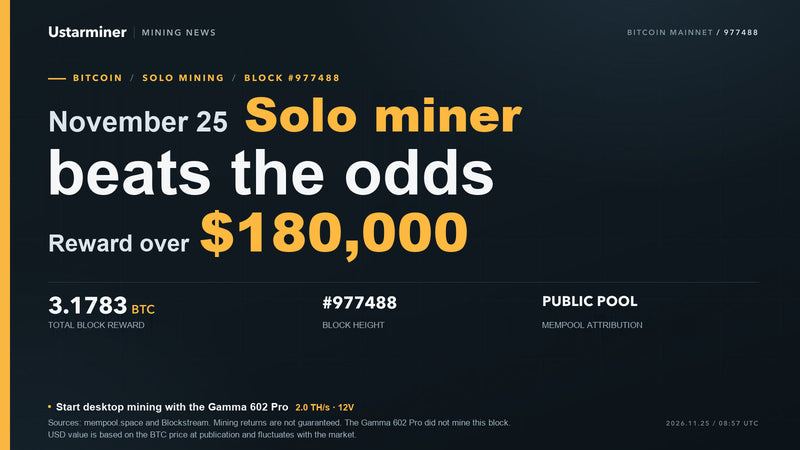
Bitcoin halves the subsidy at intervals of 210,000 blocks. The interval beginning at height 840,000, reached in 2024, has a subsidy of 3.125 BTC. Use the actual block height when checking a reward; the amount does not remain fixed forever.
The trigger is a block height rather than an appointed calendar date. Estimates of a future halving date depend on how quickly subsequent blocks arrive.
A miner finding a block in a later subsidy interval receives the amount allowed at that height. A purchase made during one interval does not reserve that interval's subsidy for a future discovery.
Why does the total reward vary between blocks?
For ordinary included transactions, fees are the difference between the value of inputs and outputs. The fees available to the block's miner depend on which transactions are included, so two blocks in the same subsidy interval can have different total rewards.
Use an actual referenced block or a clearly stated assumption when discussing the fee component. A fixed advertised prize cannot describe the transaction fees of a block that has not been found yet.
The pool's job construction chooses the candidate transaction set. The miner's accepted-share counter describes submitted hashing work; it cannot tell you what fees a future successful block will contain.
Which amount does the operator’s percentage apply to?
Read the service's written allocation rule before multiplying a percentage. Does it apply to subsidy plus fees, only the subsidy, or another stated amount? Does another configured allocation have a separate base?
A percentage applied once to the whole gross reward differs from sequential deductions or a percentage applied to only one component. “Zero operator fee” also does not answer every possible allocation question by itself.
Use CKPool's operator documentation for its own service arrangement, and the chosen operator's terms for another service. Keep the gross amount, each deduction and the participant's retained output as separate lines.
How do you calculate an illustrative retained reward?
Assume a fictional block in the 3.125 BTC subsidy period includes 0.05 BTC in transaction fees. Gross reward is 3.175 BTC. Assume, solely for arithmetic, one documented service deduction equal to 2% of the entire gross amount.
The deduction is 3.175 × 0.02 = 0.0635 BTC. Retention is 3.175 − 0.0635 = 3.1115 BTC. No future fee level or actual operator payout is predicted by this scenario.
If the deduction instead applied only to the subsidy, the result would differ: 3.125 × 0.02 = 0.0625 BTC, leaving 3.1125 BTC of the assumed gross total. The 0.001 BTC difference comes entirely from the base definition. This is why the written rule matters even when the headline percentage matches.
Why do equal percentages produce different amounts?
| Hypothetical allocation rule | Deduction | Retained amount |
|---|---|---|
| 2% of the 3.175 BTC gross reward | 0.0635 BTC | 3.1115 BTC |
| 2% of the 3.125 BTC subsidy only | 0.0625 BTC | 3.1125 BTC |
Both rows use the same assumed block and percentage. The different result comes from the rule’s base, so it cannot be resolved by rounding or by checking a miner’s hashrate. When reading a real coinbase transaction, compare all relevant outputs with the documented allocation; do not subtract an operator amount again if the finder’s output already reflects it.
How can you verify a claimed reward?
Obtain the block hash and confirm the intended network. Inspect the coinbase transaction and its outputs, then compare the documented allocation and public receiving address. A service-wide announcement may refer to a different worker.
An output to an address proves an allocation in that transaction, not the identity of the physical device that generated the winning work. Worker attribution needs credible operator or device evidence as well. Never provide a seed phrase to “unlock” or verify a reward.
A coinbase output also has protocol maturity rules before spending. Wallet display and availability should be interpreted accordingly. The existence of an output does not imply immediate ordinary spendability.
Frequently asked questions
Is the block reward always exactly 3.125 BTC?
No. That figure describes the subsidy in a particular height interval. Transaction fees vary, service allocation can reduce retention and the subsidy changes at later heights.
Are transaction fees and a pool fee the same thing?
No. Included transaction fees can increase gross block reward. An operator fee is a deduction under the service arrangement.
Does the gross reward belong to every connected solo worker?
Not under a typical solo allocation. Read the exact service rules and verify the particular worker attribution.